
You are clearing out kitchen cabinets ahead of the holidays and toss an old glass measuring cup into the donation box. The red markings have faded, the handle feels strange, and you have a newer model in the drawer anyway. Pause for a moment. That worn vessel may be significantly older than you realize, and vintage Pyrex items have a dedicated group of collectors. You do not need a specialized guide to get a general sense of its age because three specific features on the cup itself reveal most of its history.
Why the logo alone won’t date your cup
The Pyrex brand has existed for over a century. According to the Corning Museum of Glass, Corning Glass Works established the brand in 1915, and more than 150 different glass compositions have been utilized for Pyrex products since that time. Corning eventually transitioned almost all of its tableware to tempered soda-lime glass.
This history explains why the common shortcut—that all-caps “PYREX” indicates an old piece and lowercase “pyrex” indicates a new one—is not reliable. The museum clarifies that the shift from uppercase to lowercase was a trademark rebranding and does not conclusively indicate the type of glass used. Sources also disagree on exactly when the lowercase logo appeared. Collectors who have compared numerous cups agree on one point: the capital letters are a clue, not definitive proof.
The 3 details that tell you how old it is
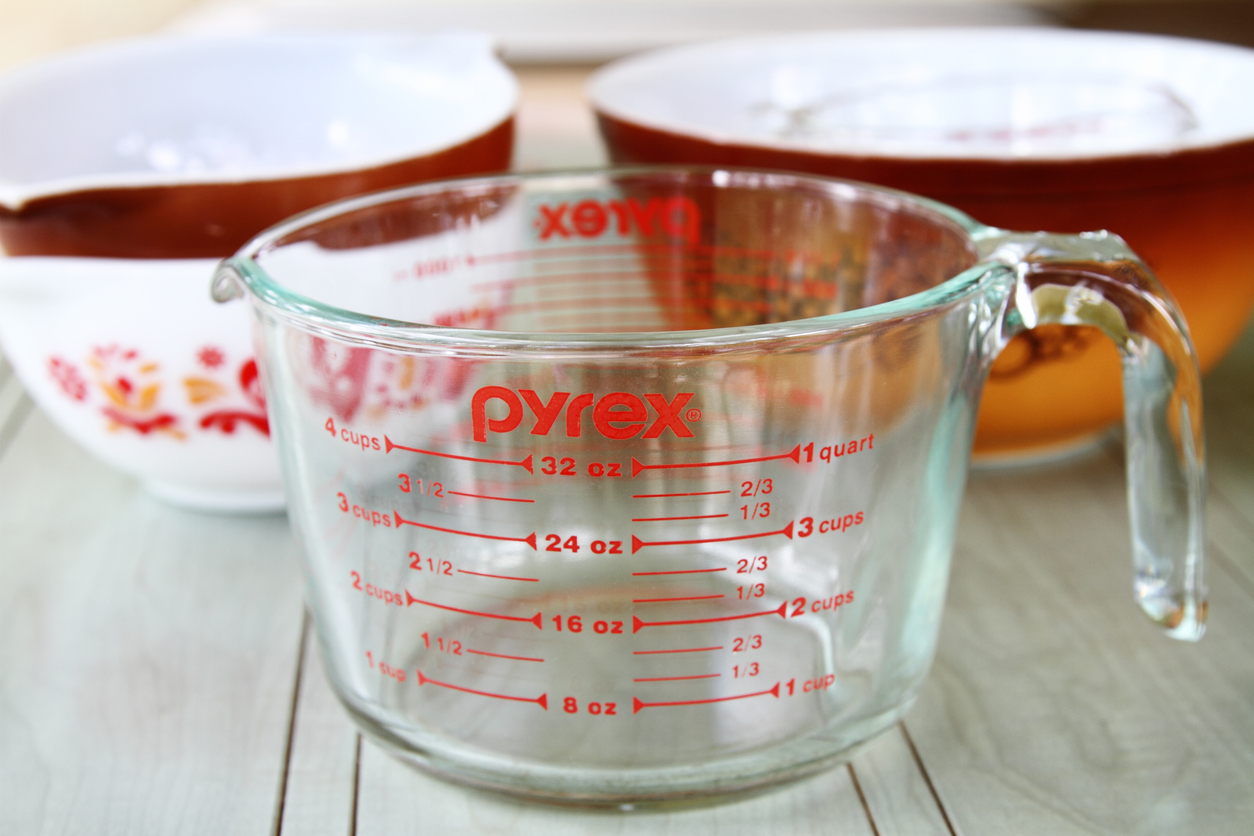
- The measurement lines. Metric markings were introduced around 1975. A cup featuring only cups and ounces, without milliliters, is likely older than that date.
- The handle. Pyrex handles underwent a redesign in the early 1980s to become the open-bottom style common in kitchens today. A handle that is closed at the bottom and forms a full loop with the cup body points to an earlier design.
- Where the logo sits. By the 1940s, cups featured red markings with the logo positioned near the spout or running vertically alongside the measurements. In the early 1980s, the logo moved to the top rim. Cups from the 1920s had raised or etched markings and lacked red ink entirely.
Look closely at the glass to find manufacturing date codes, which Corning applied as small dots and dashes to many items, according to the museum. A logo positioned beside the measurements, along with a closed handle and the absence of metric lines, makes a piece a strong candidate for being older when these three elements are combined.
Older cups are worth keeping for reasons beyond nostalgia. They frequently appear at thrift stores, garage sales, and in grandparents’ cabinets. If your cup has an unusual color or pattern, compare it with sold listings before letting it go. If you prefer to give an old thrift item new life, it requires minimal effort: a plain blue thrift store pitcher became a designer-looking vase using white spray paint and hand-painted stripes.
Before you bake with an old measuring cup
None of these details guarantees the glass type, and age alone does not make a cup valuable. Chips, cracks, and deep scratches reduce both value and safety; retire any cup with a crack, no matter how small.
Even if you are young or old, a glass cup may break when it experiences abrupt shifts in heat. You should avoid transferring it straight from the freezer to a stovetop or oven, refrain from adding boiling fluids to a chilled vessel, and ensure that warm glass is not set upon a damp or chilly base. While the faded red designs are merely decorative, flaking paint means you should reserve the cup for decoration and select a fresh one for measuring tasks.
Before placing it in the donation box, inspect the lines, the handle, and the logo. That is the key.
Source: Homedit.

























































I donated a “vintage” cup because the handle felt weird. Turns out, it was just my grip strength failing. Classic irony: I thought I was curating history, but I was just throwing away good glassware. Thanks for the reality check.
Ha! We’ve all been there. It’s easy to overthink the handle when we’re trying to be curators. But don’t worry—your taste in glassware is safe. Next time, just give it a little wiggle test. Happy collecting!