

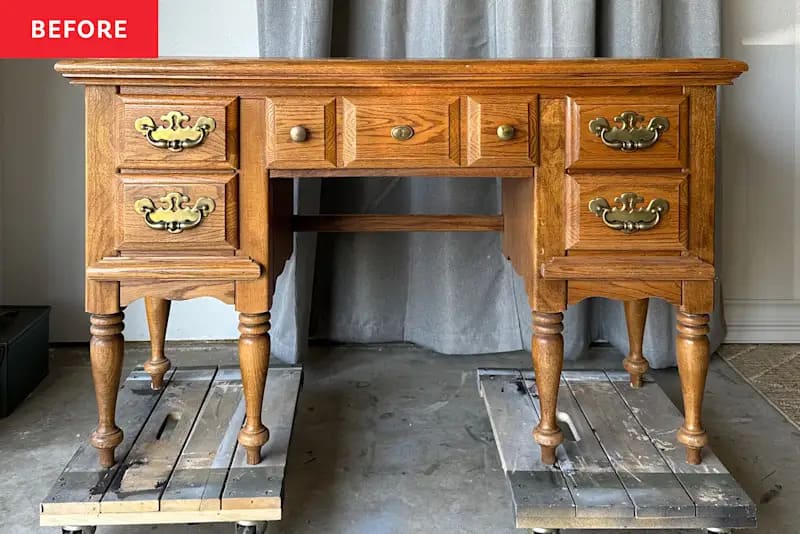
This is the quintessential desk found in countless spare rooms from the 1980s: crafted from oak, coated in a yellowed finish, and adorned with decorative handles on every drawer. Despite its perfect functionality, its appearance anchors the room in a bygone era, a problem that cannot be solved by simply adding a new lamp or rug.
The issue lay not with the desk itself, but with its surface. Furniture restorer Sheri Abernathy, known online as @brasswalnut, encountered a desk identical to this one, featuring what she describes as a "very dated finish." For approximately $100, she transformed it into a versatile piece suitable for use as either a vanity or a desk.
Reasons the orange finish aged the piece
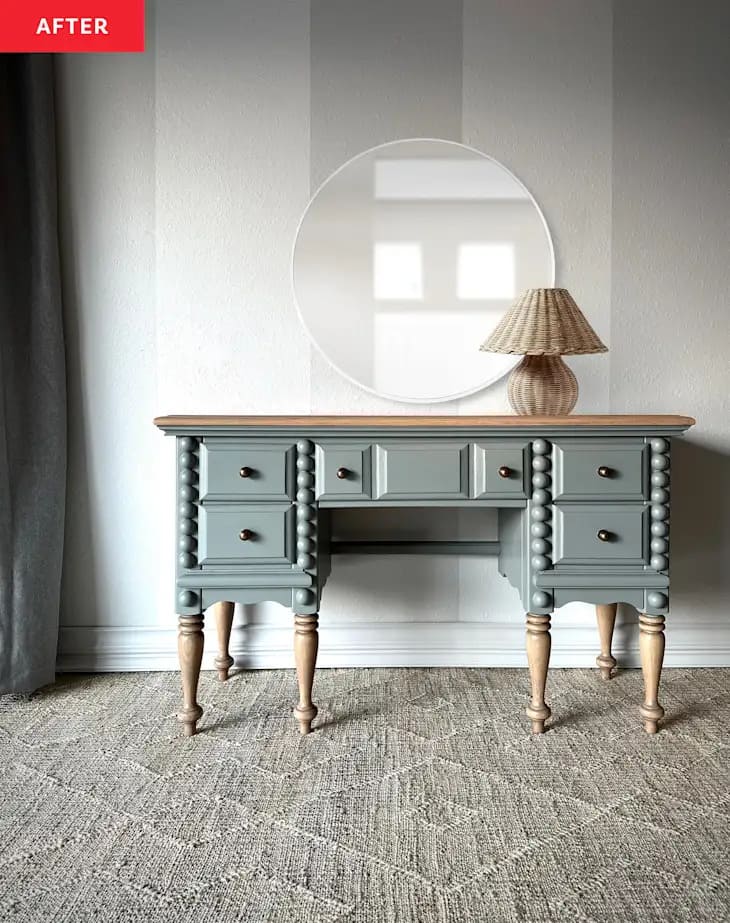
The oak material was not the culprit; rather, it was the orange coating and the decorative handles that dated the furniture. Since both elements can be altered without replacing the structure, Sheri began by scrubbing and sanding away the old finish. This approach is equally effective for older brown desks: applying a deep exterior color, such as dark blue, paired with a contrasting interior color to reveal a surprise upon opening. Sheri then painted the central section with My London Flat, an Amy Howard One Hour Miracle Paint described by the brand as a muted blue-gray. On her desk, the hue appears as a teal-gray, sufficiently cool to neutralize the lingering orange tones of the wood. "It looks so contemporary yet cute," Sheri says.
Step-by-step makeover process
Eliminate the outdated finish. Sheri removed it through scrubbing and sanding. Amy Howard’s preparation guidelines include standard steps: cleaning the surface, allowing it to dry, filling any gaps or cracks, and removing loose or peeling material.
Apply thin layers. The brand recommends using thin, uniform coats applied with long strokes using a nylon brush or a short-nap roller, requiring two coats for complete coverage. The paint becomes touch-dry in roughly 30 minutes, but one should wait at least two hours before applying the second coat.
Install the ball trim. Rather than using a strand of bobbin trim, she adhered individual wooden half-spheres using wood glue, utilizing two packs that cost $20. "I added the ball trim to make the piece look more unique and custom," she wrote on Instagram. "It also creates more of a flush front, level with the drawers."
Replace the hardware. She removed the decorative handles, filled the existing holes, and installed brass knobs with an antique appearance.
Allow time for curing. Amy Howard specifies a period of 7 to 14 days before subjecting the piece to heavy use or cleaning.
Alternative approach if stripping the entire desk seems excessive: Amy Howard states that this paint requires no sanding, priming, or topcoat, though the preparation section still suggests smoothing surfaces as necessary. Test the paint on a hidden area, such as the back or the side of a drawer, to determine the extent of sanding required.
Limitations of this finish
Temperature plays a more significant role than many realize. The brand advises against painting when the surface, ambient air, or paint temperature drops below 50°F. Ideal drying conditions are specified as 60°F to 90°F at 50% relative humidity, provided there is adequate ventilation. A cold garage in November can compromise a careful application, and a poorly ventilated room presents similar issues; the EPA notes that paints contain organic solvents and recommends increasing ventilation during use. Color perception is another variable. Some users report that My London Flat appears grayer than in photographs, while others perceive a gray-green tint. Paint a test patch and evaluate it under both daylight and artificial light before making a final decision. Finally, consider daily wear and tear. Since full curing requires 7 to 14 days, avoid placing heavy objects, mugs, or cleaners on the surface until then to prevent marking before the finish hardens. By removing the orange tone while preserving the original shape, a single cool color and a row of wooden spheres complete the transformation. That is the secret.
The article Instead of keeping this ’80s oak desk orange, she painted it My London Flat teal-gray was originally published on Homedit.

































So we sand off perfectly good wood to paint it a color that mimics the sky, just to prove we have time? Truly, the pinnacle of 2024 interior design.
Haha, I see your point! While sanding oak feels like a waste, that teal-gray finish actually protects the wood while giving it a modern update. It’s less about proving we have time and more about loving a refreshed piece. Thanks for sharing your honest take!